
1. Introduction
In the realities of the 21st century, characterized by deep economic interconnections and interdependencies, global connectivity through the internet and emerging technologies, as well as the growing impacts of climate change as a transboundary environmental challenge, the problems humanity faces are becoming increasingly complex. Moreover, they also increasingly intersect, often amplifying one another. Understanding these interconnections is crucial to ensuring effective policy responses.
Climate change is widely recognized as one of the most severe and long-term threats to global society. It is a multidimensional phenomenon linked to nearly every major issue. While some of these connections are well-documented and reflected in policy frameworks, others remain underexplored and insufficiently considered by decision-makers.
The relationships between climate change, migration, and human trafficking are diverse, multidirectional, and difficult to isolate from broader geopolitical, social, and ecological dynamics. Nevertheless, it is essential to disentangle this nexus, identify its most significant linkages, and assess how such analysis can inform more effective policies and practical responses to criminal networks that undermine the fundamental rights of the most vulnerable populations.
This paper offers an interpretation of the topic and represents an attempt to unpack this 3-factor nexus by incorporating the authors’ perspectives. It does not claim to provide a fully comprehensive or academically novel contribution; rather, it seeks to map the interconnections among these three phenomena that have received increasing academic and political attention in recent years. The paper also attempts to examine additional linkages in order to contribute to a more nuanced understanding of these interconnections, including through the application of a systems-thinking approach. Although the complexity of these phenomena and their interactions limits the scope of this overview, the paper aims to provide a foundation for further research and to support the development of more integrated and effective policy responses.
2. Historical background of the three phenomena
2.1 Migration
Migration is an inherent feature of humankind – a natural and inevitable phenomenon. As William Lacy Swing, former Director General of the United Nations’ (UN) Migration Agency – the International Organization for Migration (IOM), describes it, migration is “history’s oldest and most effective anti-poverty measure, a natural human response to challenges and a facilitator of greater opportunities” (Swing, 2016).
To date, there is no legal definition of “migration” or “migrant” existing in international law. The IOM defines “migration” as “the movement of persons away from their place of usual residence, either across an international border or within a State”, and “migrant” as “a person who moves away from his or her place of usual residence, whether within a country or across an international border, temporarily or permanently, and for a variety of reasons” (IOM, 2019).
2.1.1 Environmental and climate migration
Among the various reasons that drive individuals to migrate are environmental factors and the living conditions they shape. The IOM (2019) defines “environmental migration” and “climate migration” in a similar manner, considering the latter a subcategory of the former. As is the case with “migration” as a broader term, neither concept has legal recognition, and both are used by the IOM as working definitions.
| Environmental migration | Climate migration |
|---|---|
| The movement of persons or groups of persons who, predominantly for reasons of sudden or progressive changes in the environment that adversely affect their lives or living conditions, are forced to leave their places of habitual residence, or choose to do so, either temporarily or permanently, and who move within or outside their country of origin or habitual residence. | The movement of a person or groups of persons who, predominantly for reasons of sudden or progressive change in the environment due to climate change, are obliged to leave their habitual place of residence, or choose to do so, either temporarily or permanently, within a State or across an international borders. |
Climatic changes have always been major drivers of migration, as life on Earth has long been shaped by the climate (Tandon, 2024). Earth’s unique carbon-regulated climate is the essential factor that allows water to exist in multiple states, creating the stable environment necessary for life to emerge – a balance not found on any other known planet (IPCC, 2007, p. 126). Species, including homo sapiens, evolve in response to their surrounding environments, and when conditions change, they must either adapt or relocate to areas that offer habitable conditions (Tandon, 2024). In this sense, neither environmental nor climate migration is a novel phenomenon.
2.2 Climate change
The Earth’s climate has undergone numerous changes throughout its history. There have been many ice ages and warmer periods, but both have shifted and lasted for millennia (NASA, 2024). Climate change, as it is understood today within scientific, political, and public discourse, refers to anthropogenic climate change caused by excessive greenhouse gas emissions resulting from human activity in the last two centuries (Intergovernmental Panel on Climate Change [IPCC], 2007, p. 3-4). The United Nations Framework Convention on Climate Change (UNFCCC) signed in 1992 by 198 parties was the first legal document on the international level to recognize anthropogenic climate change, defining it as “a change of climate which is attributed directly or indirectly to human activity that alters the composition of the global atmosphere and which is in addition to natural climate variability observed over comparable time periods”.
As reported in the Intergovernmental Panel on Climate Change (IPCC1 ) report from 2007, the increase in greenhouse gas concentrations in the atmosphere over the past two centuries has occurred at both a rate and a scale that are very likely2 unprecedented in at least the last 10,000 years. This has led to an increase in both frequency and intensity of sudden-onset/rapid-onset disasters (extreme weather events and extreme climate events) such as temperature extremes, heatwaves, floods, droughts, heavy precipitation, storms, and heatwaves (Seneviratne et al., 2021). At the same time, broader climate change processes are driving slow-onset environmental changes, including sea level rise, increasing temperatures, ocean acidification, glacial retreat and related impacts, salinization, land and forest degradation, loss of biodiversity and desertification (UNFCCC, 2012).
Anthropogenic greenhouse gas emissions disrupt the delicate balance of the global ecosystem, posing a risk to the living world. As climate is a fundamental condition for life on Earth, and social systems are inherently dependent on ecosystems, changes in the environment affect populations by both intensifying existing social issues and giving rise to new ones. As the impacts of climate change intensify, they are increasingly intersecting with major global challenges, including trafficking in human beings.
2.3 Trafficking in persons
Trafficking in human beings, often referred to as modern-day slavery, is one of the most severe violations of human dignity and human rights. In recent years, the number of detected victims has increased significantly at the global level. While this may partly reflect improved detection capacities of relevant institutions, it also indicates growing vulnerabilities within societies and social systems that enable this form of organized crime to persist, posing a risk to global security.
This phenomenon dates back to the earliest stages of human history, evolving from systems of forced labour in ancient societies to the large-scale Transatlantic Slave Trade (16th–19th centuries), and, following the abolition of slavery, to contemporary forms of exploitation, including human trafficking (Giovagnoni & Van Schooneveld, 2022).
“Trafficking in persons,” as defined in the Palermo Protocol3, supplementing the UN Convention against Transnational Organized Crime, refers to “the recruitment, transportation, transfer, harbouring or receipt of persons, by means of the threat or use of force or other forms of coercion, of abduction, of fraud, of deception, of the abuse of power or of a position of vulnerability or of the giving or receiving of payments or benefits to achieve the consent of a person having control over another person, for the purpose of exploitation. Exploitation shall include, at a minimum, the exploitation of the prostitution of others or other forms of sexual exploitation, forced labour or services, slavery or practices similar to slavery, servitude or the removal of organs.”
Although slavery was formally abolished worldwide by the 20th century and international efforts to combat trafficking have expanded, human trafficking persists, adapting to contemporary global dynamics and exploiting legal gaps, socio-economic vulnerabilities, and technological developments. There is growing evidence that environmental degradation and climate change intersect with and amplify existing vulnerabilities, such as poverty and climate-induced migration, thereby increasing the risk of affected populations being exploited and trafficked.
3. The nexus between climate change, migration, and human trafficking
3.1 Terms used in the context of climate mobility
Climate-induced movement of people has led to the use of the terms “climate migrant”, “climate refugee”, and “displaced person” in public discourse, academic literature, the media, and sometimes even policy (in some regions), often in an interchangeable manner. However, these terms differ significantly in both meaning and legal status.
3.1.1 Climate refugees
The term “climate refugee” is not recognized under international law. The 1951 Refugee Convention and its 1967 Protocol, which provide the internationally recognized definition of a refugee4 do not include environmental or climate-related factors as grounds for refugee status. Initially, the United Nations High Commissioner for Refugees (UNHCR) has criticized the term “climate refugees” as it blurs the boundaries between the definition of refugees according to the 1951 Convention and other popular notions of refugees in public discourse (Apap & Harju, 2023). Later, in 2019, the Head of the Migration, Environment and Climate Change (MECC) Division at the IOM – Dina Ionesco – argued that adding “climate refugees” to the 1951 Convention would not only weaken it, but it would also exclude from aid and support climate-displaced people who could often unable to prove that their forced displacement is due to the changing climate and its impacts (Ionesco, 2019).
At the European level, climate change has been recognized in the context of the European Green Deal as a threat multiplier and a driver of instability, contributing to migration and population displacement (European Commission, 2019). In 2018, the European Commission proposed the establishment of an asylum, migration and integration fund aimed at addressing the root causes of irregular migration, including underdevelopment, demographic pressures, limited economic opportunities, climate change, and inequality. This initiative is linked to the New Pact on Migration and Asylum from 2020, which seeks to strengthen asylum systems and improve the integration of migrants. However, the Pact does not recognise climate change as a legal ground for migration or as a valid basis for asylum claims. Although a number of developing countries have called for the recognition of climate migrants as refugees, some EU Member States have not supported this approach. Instead, the EU has primarily focused on addressing the root causes of climate-induced migration, promoting global climate action – for example, through the European Green Deal, as well as through the ongoing implementation of the EU Biodiversity Strategy for 2030, which seeks to enhance resilience to the impacts of climate change (Apap & Harju, 2023).
3.1.2 Internally displaced persons
Another term used in the context of climate-induced mobility is “internally displaced person” (IDP). IDPs are “persons or groups of persons who have been forced or obliged to flee or to leave their homes or places of habitual residence, in particular as a result of or in order to avoid the effects of armed conflict, situations of generalized violence, violations of human rights or natural or human-made disasters, and who have not crossed an internationally recognized state border.”
The definition of an IDP is set out in the UN Guiding Principles on Internal Displacement. The latter constitute the main international framework for the protection of such individuals. However, they are not legally binding, although their authority has been widely recognized, particularly as they draw on international humanitarian and human rights law.
The main difference between a refugee and an IDP is that IDPs remain citizens/habitual residents of their own countries and as such, they are entitled to all the rights and guarantees. Therefore, the primary responsibility for IDP protection remains to national authorities.
3.1.3 Climate migrants
Even though climate migration is predominantly internal, some forcibly displaced people cross international borders, thereby becoming externally displaced. Despite being a recurring topic in international negotiations, the lack of an official definition and legal recognition contributes to limited protection for affected individuals, which in turn deepens their vulnerabilities (Apap & Harju, 2023).
As noted above, a climate migrant is a person who is compelled or chooses to leave their habitual place of residence, either temporarily or permanently, within a state or across international borders, primarily due to sudden or gradual environmental changes associated with climate change.
Two main forms of human mobility can be distinguished depending on the nature of environmental change. Sudden-onset events (floods, storms, and wildfires) tend to result primarily in internal displacement, placing affected populations within the category of internally displaced persons (IDPs). In contrast, slow-onset processes (rising temperatures, sea-level rise,etc.) are more often associated with migration, which represents a broader category encompassing both internal and cross-border movement. Migration may be either forced or voluntary, as individuals and households respond to both immediate shocks and gradually deteriorating living conditions (Tandon, 2024). In this sense, migration can be understood as the broader category, within which internal displacement represents a specific subset.
For the purposes of this paper, the term “climate migration” will be used to encompass both internal and cross-border displacement.
3.2. Climate change impacts on socio-ecological systems
Climate change (both in the form of gradual environmental changes and extreme weather events) has a profound impact on socio-ecological systems5. The International Institute for Environment and Development (IIED), which conducted empirical research on the climate change-migration-human trafficking nexus in two districts in India, reports a range of impacts that exacerbate pre-existing vulnerabilities among affected populations, contributing to migration and, subsequently, increasing the risk of trafficking.
These impacts include:
- anomalies in rainfall patterns and increased droughts, reducing agricultural productivity; loss of forests, which can reduce groundwater levels and subsequently affect agricultural production; changing weather conditions that increase disease prevalence and insect infestations, drastically affecting yields; reduced availability of indigenous foods from forests and local water bodies; all of the afore-mentioned leading to food insecurity and economic hardship;
- a decline in natural resources on which communities depend for economic activities and livelihoods;
- changes in food chains – for example, wild animals feeding on resources used by communities, resulting in loss of income;
- water scarcity due to extended dry spells, which creates difficulties in meeting basic needs such as drinking, cooking, bathing, and cleaning, and also affects agriculture and other water-dependent economic activities;
- losses and damage to infrastructure, particularly during extreme weather events (Bharadwaj et al., 2022).
These examples illustrate how deeply interconnected ecological and social systems are, and how environmental disruptions translate into significant challenges for local communities. They demonstrate the strong dependence of social systems on ecosystems, implying that environmental degradation must be addressed with greater urgency. If left unaddressed, such impacts not only undermine basic human needs but also human rights, contribute to insecurity and loss of life, and create opportunities for criminal networks to exploit heightened vulnerabilities.
3.3. The impact of climate change on human mobility
Climate change is largely recognized as a factor that shapes human mobility in the present day. However, as migration is a complex phenomenon, it is often difficult to identify a single factor driving individuals or households to migrate, whether internationally or within a state. Climate change interacts with a range of other drivers – including economic, political, demographic, social, and environmental factors – making migration decisions inherently multi-causal (Ionesco, 2019). However, climate change is increasingly emerging as a significant driver of human mobility, often characterized as a threat multiplier – a factor that exacerbates existing vulnerabilities.
One clear indicator of this trend is the rising number of people internally displaced by climate-related events (Bharadwaj et al., 2022). According to the Global Report on Internal Displacement, 9.8 million people were displaced by disasters in 2024, resulting in 45.8 million internal displacements. The latter figure indicates that many individuals were displaced multiple times, often for short periods. Notably, the number of disaster-related displacements in 2024 was nearly double the annual average of the past decade (The Internal Displacement Monitoring Centre, 2025).
Although climate migration is predominantly internal, some forcibly displaced individuals cross international borders, thereby becoming externally displaced (Apap & Harju, 2023). The fact that climate change is not yet recognized under international law as a ground for seeking asylum, the lack of data on externally displaced people, combined with the tendency of climate migrants to rely on irregular migration pathways, makes it difficult to fully assess the impact of climate change on human mobility. In a worst-case scenario, up to 1.2 billion people are predicted to be displaced by 2050 due to natural disasters and other ecological threats (Institute for Economics and Peace, 2020).
Climate-driven migration is associated with severe forms of exploitation in at least three ways: (i) slow-onset disasters, including gradual environmental changes such as droughts and crop failures; (ii) rapid-onset disasters, such as floods and cyclones; and (iii) the combined effects of conflict and climate-related events (Bharadwaj et al., 2022).
3.3.1. Sudden-onset disasters
Sudden-onset disasters are triggered by hazardous events that emerge quickly or unexpectedly. Climate-related sudden-onset disasters are, for example, floods, cyclones, tornadoes, landslides, wild fires, etc. Depending on their severity and the affected populations’ vulnerabilities and adaptive capacity, they could result in temporary or protracted displacement (United Nations High Commissioner for Refugees [UNHCR], n.d.). This is because sudden-onset events can cause extensive loss and damage to crops, livestock, land, property, equipment, and even homes. In these circumstances, communities often have limited or no options for in-situ adaptation, making migration the only viable means of survival, especially for people without safety nets who are instantly plunged into poverty (Bharadwaj et al., 2022).
3.3.2. Slow-onset disasters
Slow-onset events evolve gradually, either from incremental changes occurring over many years or from an increased frequency or intensity of recurring events (UNHCR, n.d.). Examples include recurrent droughts, coastal erosion, sea-level rise, desertification, and glacial retreat, all of which threaten natural resource-based livelihoods such as agriculture, livestock, and fisheries (Bharadwaj et al., 2022). Gradual environmental changes, particularly when irreversible, undermine ecosystems and resource availability, thereby contributing to food insecurity and long-term economic instability (Brouwer, 2025). They undermine people’s ability to sustain their livelihoods, often leading to increased debt and poverty. As a result, households may be motivated or forced to consider migration in search of better economic opportunities. Migration can thus serve as a coping strategy that enables the diversification of livelihoods (Bharadwaj et al., 2022). This is enhanced by the fact that usually disaster risk reduction responses and social protection programmes are focused primarily on sudden onset-events, because of their higher visibility and perceived urgency (Brouwer, 2025).
3.3.3. The intersection of climate change and conflict
Climate change has been widely recognized as a threat multiplier by scientists, civil society, and policymakers, including in relation to peace and security. The IOM also states that climate change can cause or least contribute to situations of conflict and instability, which then trigger migration flows (IOM, 2016). However, the extent of its impact and the nature of the risks it poses remain subjects of ongoing debate. The fact that the United Nations Security Council convened a meeting just two months after 197 parties to the UN Climate Change Convention agreed on a concrete pathway for implementing the 2015 Paris Agreement (United Nations, n.d.) underscores the growing international concern over the security implications of climate change and highlights its increasing prominence on the global political agenda.
The following example illustrates how complex, intersecting factors can make it difficult to attribute outcomes to a single driver. In the case of the Syrian Civil War that caused one of the worst refugee crises, the conflict has been framed as a “climate conflict” due to a severe drought between 2007 and 2009. However, a report by the United Nations University Institute for Water, Environment and Health challenges this widely circulated narrative, arguing that the crisis was driven primarily by long-term governance failures and maladaptive agricultural and economic policies rather than climate change alone.
Drawing on satellite data and field research, the study shows that rural collapse and farmland abandonment began well before the drought, largely as a result of subsidy cuts, structural inequalities, and unsustainable farming practices. Although the drought was severe, Syria’s agricultural sector demonstrated resilience and even recovered shortly before the outbreak of war. Migration prior to 2011 was largely a common coping strategy, but it became forced and permanent only after the onset of violent conflict.
The report concludes that labeling the Syrian war as a “climate conflict” oversimplifies a complex reality and diverts attention from deeper political and economic drivers, particularly poor governance (Von der Kammer et al., 2025).
While the conflict cannot be directly attributed to climate change, these governance failures were closely tied to the mismanagement of natural resources and a disregard for socio-ecological systems, highlighting how the neglect of human-environment interdependencies can deepen vulnerability.
3.4. The relation between climate change and trafficking in persons
Climate change increases the risk of human trafficking both in origin areas affected by environmental stress and during migration. Despite the fact that, the effect of sudden-onset disasters on trafficking is often more clearly evident in comparison to the impact of slow-onset disasters (IOM, 2017), this activity has been shown to increase in areas affected by gradual processes as well as in those impacted by rapid-onset events (Bharadwaj et al., 2022).
Depending on the context, sometimes slow-onset events could even lead to higher rates of human trafficking. For example, research by the International Institute for Environment and Development (IIED) indicates that trafficking rates were significantly higher in a district in an Indian state affected by slow-onset climate events compared to one impacted by rapid-onset disasters. This disparity can be attributed to the fact that slow-onset disasters typically receive less attention than sudden events. In such cases, moderate droughts must be addressed by state governments using their own resources, which can delay official recognition. Consequently, some states neglect declaring drought conditions until they become severe enough to qualify for federal assistance. As a result, many droughts go unreported or are declared too late, pushing communities into distress migration as they struggle to sustain their livelihoods and access basic necessities (Bharadwaj et al., 2022).
3.4.1. Recruitment at affected (source) areas
Criminal networks conducting trafficking in persons target affected regions and take advantage of vulnerable individuals who are in search of opportunities to restore their lives after disasters, being aware that such people are likely to be more prone to resort to high-risk behaviours and potentially dangerous coping strategies. For example, after Cyclone Sidr in 2007 in Bangladesh, research showed that criminal networks began to operate in the affected region (Munns & Katz, 2023).
Affected populations out of desperation could also see as an option colluding with criminal actors. For example, there have been cases of men selling their wives/other female relatives or parents selling their children (also a form of trafficking in persons) – seen as coping strategies in the context of severe impacts of a changing climate (Bharadwaj et al., 2022).
Even though trafficking is associated mostly with mobility, there are disaster-affected people are unwilling or unable to move. This involuntary immobility can leave populations highly vulnerable, as the ability to move is often a crucial coping strategy in response to livelihood loss (Brower, 2025).
3.4.2. Recruitment during migration
Apart from targeting the source areas of forcibly displaced populations, individual recruiters and criminal networks target migrant destinations as well – e.g., in the urban slums displaced people are relocated to or in refugee camps established to shelter internally displaced people. Usually these camp-like settings are overcrowded, lack social cohesion, security, as well as access to social services, offer few employment opportunities, and are characterized by competition for resources like food or water. Recruiters/traffickers integrate into the camp environment, earn trust among inhabitants, which helps them identify potential victims. Especially when displaced people are forced to spend longer periods of time in these settings, they become increasingly desperate, and fall victims of forced labour, debt bondage, sexual exploitation, or are forcibly married (Munns & Katz, 2023).
3.5. Vulnerability of climate-induced migrants to human trafficking
In a publication dedicated to the nexus between climate change and human trafficking, the International Organization for Migration (2017) states that “migrants who report war, conflict, or natural disasters as the main reason for leaving their places of origin are more likely to be vulnerable to exploitation and human trafficking during their journey than those who migrate for other reasons.”
There are multiple factors underlying the vulnerability of climate migrants to human trafficking, both during transit and at their destination. Some of the most significant among them are as folllows:
Firstly, the nexus between climate change, migration, and trafficking in persons is most evident among populations living in precarious or uncertain economic conditions (e.g. poverty, unemployment, high indebtedness, lack of education, etc.). It is not necessarily the areas most exposed to environmental and climate hazards that experience the most severe impacts leading to migration and trafficking, but rather those where communities lack the capacity to cope with these impacts and where populations already face economic hardship and limited resources to respond to extreme weather events (Munns & Katz, 2023). Consequently, climate change amplifies existing economic vulnerabilities, increasing susceptibility to exploitation and making affected populations more likely to resort to high-risk coping strategies as irregular migration that may expose them to human trafficking.
However, it is not only economic hardship and loss of shelter that drive people to adopt such coping strategies. Factors such as loss of access to essential infrastructure, including healthcare, education, and social services, as well as the erosion of social networks, cultural heritage, and community support, can also play a significant role (Brower, 2025).
An important factor is the nature of climate change impacts, particularly extreme weather events. Climate-induced migration is often categorized as a form of distress migration, placing affected individuals in situations characterized by a lack of alternative options (Avis, 2017). Additionally, the significant strain on livelihoods accelerates migration decision-making among affected populations. This often results in unplanned/poorly planned migration as a risky coping strategy, thereby increasing vulnerability to exploitation and the risk of human trafficking (Brennan & Yea, 2025). Apart from the urgency of displacement, disaster-affected populations often face economic constraints, which contribute to their reliance on irregular and unsafe migration pathways that are perceived cheaper than regular migration channels (IOM, 2017).
Therefore, climate-induced migration is largely unregulated – individuals are not formally registered, which makes the tracking of their movement difficult (Bharadwaj, 2022). By crossing international borders irregularly (being undocumented), individuals have limited access to government support, legal and labour protection in transit and destination countries (Munns & Katz, 2023). Together these factors increase vulnerability to exploitation, and consequently, undocumented migrants constitute a significant share of victims of human trafficking (World Bank, 2023).
As a coping mechanism, individuals affected by climate-related disasters, could seek assistance from migrant smugglers. However, this activity increases the chances of smuggled people to become victims of trafficking (IOM, 2017).
3.5.1. Other contributing factors
The role of unscrupulous recruitment agents in facilitating labour migration represents an additional contributing factor. These intermediaries often enable movement from rural communities to areas with a high demand for low-cost labour. Migrants frequently lack formal employment contracts or written agreements with employers or intermediaries, which limits their access to legal protection (Bharadwaj, 2022). At the same time, some recruitment practices have been linked to exploitative outcomes, including forced labour.
For example, in the Sundarbans, after climate change-related disasters, it was reported that labour recruiters and contractors have exploited the unstable conditions of affected communities by recruiting individuals – particularly women and children – through deceptive promises of employment or marriage. Reflecting existing gendered divisions of labour, many women and girls were subsequently trafficked into sectors with high demand, such as domestic work, the sex industry, and forced marriage, while boys were trafficked for forced labour across various sectors (Molinari, 2017).
Another factor that plays an important role is the already existing human trafficking activity in the affected regions. Most of them are low-income populations who are already vulnerable to and become victims of trafficking. The law enforcement systems of the respective governments already struggle to deal with trafficking and other types of modern slavery in “normal” times, and in times during and after a disaster, it becomes even more difficult and many of these populations are left unprotected.
3.5.2. Socio-political factors on the national level
It is important not to overlook socio-political factors when addressing climate change and its related impacts. Lack of or inadequate support systems (disaster management strategies and social protection programmes) also lead to deepening of vulnerabilities, which decreases resilience and adaptive capacity of societies. The vast majority in low- and middle-income countries usually have insufficient resources and infrastructure to provide the humanitarian, economic and social protection for forcibly displaced persons (Munns & Katz, 2023). At the same time, absence of or inadequate early warning systems for climate-related hazards play a crucial role in failure of socio-political systems to safeguard livelihoods, lives, and assets. (Bharadwaj, 2022). Therefore, malfunctioning of the rule of law and poor governance structures also play a role in both prevention and post-disaster management (Munns & Katz, 2023).
For example, evidence from the two studied districts in India, which exemplify the nexus between climate change, migration, and human trafficking, shows that affected populations often lack adequate strategies and resources to manage climate-related risks. This includes insufficient infrastructure to cope with floods and cyclones, limited access to facilities such as flood shelters, irrigation systems, community centres, and reliable drinking water sources, as well as inadequate provision of relief materials following disasters. In such contexts, some of the most vulnerable individuals have been found to resort to high-risk coping strategies – irregular migration that resulted in trafficking (Bharadwaj, 2022).
3.5.3. Gender-specific dimensions
According to UNICEF, climate change heightens the likelihood that girls could be forced into unsafe migration or displacement pathways, increasing their exposure to risks of modern slavery. Girls are particularly vulnerable to trafficking, especially during and after extreme weather events. These risks are further intensified when they are responsible for collecting essential resources such as food, water, and firewood, or when they reside in temporary shelters or refugee camps (Pegram & Colon, 2020).
At the same time, research from the Sundarbans and other regions in India indicates that, in post-disaster contexts, higher rates of gender-based violence, exploitation, and human trafficking – particularly affecting women and girls – have been reported. These outcomes are linked to factors such as family fragmentation and stress, loss of livelihoods and support networks, disruption of social norms and protective structures, displacement into insecure disaster relief camps, and heightened physical and socio-economic vulnerability (Molinari, 2017).
The IOM (2017) also suggests, based on existing evidence, that women and female-headed households are particularly vulnerable to trafficking, as well as children who are displaced or orphaned during climate-related disasters. However, the organization also highlights the need for further research to better understand differences in vulnerability to human trafficking among men, women, boys, and girls in the context of a changing climate.
3.6. Examples of the nexus and existing evidence
There has been growing empirical evidence about the links between climate change, migration and human trafficking. Climate change induces high-risk migratory patterns to both rapid and slow-onset disasters, which exacerbates affected populations’ vulnerability to trafficking and slavery-like practices (Munns & Katz, 2023).
3.6.1. The Asia-Pacific region
In a dedicated publication, the IOM (2017) outlines examples from the Asia-Pacific region that illustrate the nexus between climate change, human mobility and trafficking in persons. The region is the world’s most populous region, with more than 4.2 billion people. It is also characterized by high levels of human mobility, including both internal and international migration, as well as regular and irregular migration flows, including human trafficking. Migration within the region is predominantly internal, often taking the form of rural-to-urban movement. Human trafficking frequently occurs along these same routes and is carried out by organized criminal networks, with major destination countries including India, Malaysia, and Thailand. Irregular labour migration is often associated with forms of exploitation commonly linked to human trafficking.
At the same time, the region is among the most vulnerable to the impacts of climate change, being exposed to a wide range of natural hazards. These include both sudden-onset events, such as cyclones and floods, and slow-onset processes, such as droughts and sea-level rise. These climate-related events significantly influence human mobility, with millions of people displaced across the region each year. A notable trend is the increasing number of people displaced for prolonged periods, often forced to live in camps or camp-like settings. Environmental and climatic changes can therefore trigger high-risk forms of migration, driven by both sudden and slow-onset events.
There is also documented evidence of increased risks of human trafficking during and after natural disasters, including the Indian Ocean tsunami (2004), Cyclone Sidr in Bangladesh (2007), and Typhoon Haiyan in the Philippines (2013). In such contexts, criminal networks have been found to target affected populations, particularly vulnerable groups such as children, widows, and individuals seeking to migrate for employment. In some cases, even entire families have been targeted, and especially female-headed households have been exposed to heightened risks of exploitation.
3.6.2. Geographical scope of existing evidence and EU Implications
Certain regions of the world have proven to be particularly vulnerable to the increasing frequency and intensity of climate-related disasters, as well as to human trafficking. These include lower- and middle-income countries in South Asia, East Asia and the Pacific, Sub-Saharan Africa, and the Middle East. These regions are characterized by high exposure to natural hazards, limited capacity for adaptation, and large populations dependent on natural resources (Brouwer, 2025). As most existing empirical evidence on the climate change-migration-human trafficking nexus is based on research conducted in these regions, findings may vary in other geographical contexts.
While certain regions are disproportionately affected, no country or region is immune to either climate change or trafficking in persons, as both are global phenomena. Evidence suggests that climate change can exacerbate vulnerabilities across diverse socio-economic contexts, although its impacts are often most visible in regions already facing structural challenges.
The afore-mentioned research by the IIED demonstrates that this dynamic is not limited to traditionally vulnerable regions. A comparative study of two districts in India (Palamu and Kendrapara) shows that even relatively prosperous and stable regions can become highly vulnerable under increasing climate stress. Kendrapara, once among the most fertile and economically stable districts in Odisha, historically attracted migrants due to its productive land and favourable conditions. In contrast, migration in the region has emerged as a relatively recent phenomenon, driven by the growing impacts of climate change, including more frequent cyclones, flooding, sea-level rise, and land degradation. These changes have undermined livelihoods, leading to declining incomes, unemployment, and rising indebtedness (Bharadwaj, 2022).
Despite higher levels of literacy, better infrastructure, and stronger economic conditions compared to Palamu, populations in Kendrapara have also become increasingly vulnerable. In both districts, it is the most vulnerable groups who are disproportionately affected and are more likely to fall victims to trafficking. This highlights that while pre-existing socio-economic conditions shape vulnerability, climate change can act as a powerful stress multiplier, extending risks even to populations that were previously relatively secure.
In this context, although there is currently no empirical evidence directly linking climate change, migration, and human trafficking within the EU, a briefing from the European Parliamentary Research Service suggests that the EU may need to reconsider its perspective on climate-related mobility – not only as a destination for displaced populations from abroad, but also as a region experiencing internal climate displacement. While current policy frameworks, such as the European Green Deal, primarily focus on addressing the root causes of climate change, insufficient progress in emissions reduction may necessitate greater attention to the impacts of climate change, including climate-related migration (Apap & Harju, 2023). Migration, on its end, could possibly heighten vulnerabilities among affected regions and populations, thereby creating conditions that could be exploited by criminal networks, including those involved in human trafficking.
4. Additional dimensions of the climate change – human trafficking relationship
Migration does not inherently lead to trafficking; however, without proper regulation, it can increase vulnerability to exploitation. At the same time, migration can have several positive effects on households. It can improve health and nutrition, increase purchasing power, and diversify income. Migration may also enhance economic security, expand access to education and employment opportunities, and help households cope with climate-related stress, enabling them to move out of cycles of debt and poverty while strengthening their capacity to save and invest (Bharadwaj et al., 2022).
These findings suggest that migration is not inherently negative; rather, it needs to be safe, voluntary, and well-regulated to ensure that individuals are protected and able to make informed choices.
4.1 Climate Change and labour exploitation
Climate change not only contributes to increased vulnerability to trafficking, but also exacerbates exploitative labour conditions. As highlighted by Brennan and Yea (2025), already precarious forms of work can more easily shift into situations of extreme exploitation or trafficking in the context of the climate crisis. In many regions, working conditions are deteriorating due to rising temperatures, environmental degradation, and the increasing frequency of extreme weather events, in some cases becoming even life-threatening.
At the same time, climate change further worsens the conditions experienced by individuals already subjected to exploitation or trafficking. Victims of trafficking, who often work in informal or unregulated sectors such as agriculture, construction, or fisheries, are particularly exposed to environmental hazards. As climate impacts intensify, these workers may face longer hours under extreme weather conditions, reduced protections, and increased physical risk, deepening their vulnerability (Brennan & Yea, 2025).
4.2 A systems perspective: feedback loop dynamics between climate change and trafficking in persons
Human trafficking and climate change are also linked through non-linear relationships that can form reinforcing (positive) or balancing (negative) feedback loops.
As discussed in this paper, climate impacts increase vulnerability to trafficking. At the same time, many sectors associated with forced labour and exploitation – such as intensive agriculture, cattle ranching, fisheries, forestry, mining, and construction – are significant contributors to environmental degradation and climate change. In this way, exploitative practices not only arise from climate-induced vulnerability but also contribute to further environmental damage, which in turn exacerbates climate change impacts. This creates a reinforcing cycle in which climate change drives vulnerability and exploitation, while exploitation further intensifies environmental degradation. Human mobility in the absence of safe and regular pathways represents a key element of this nexus, acting as a major risk factor for trafficking in persons that is increasingly influenced by climate change (Brouwer, 2025).
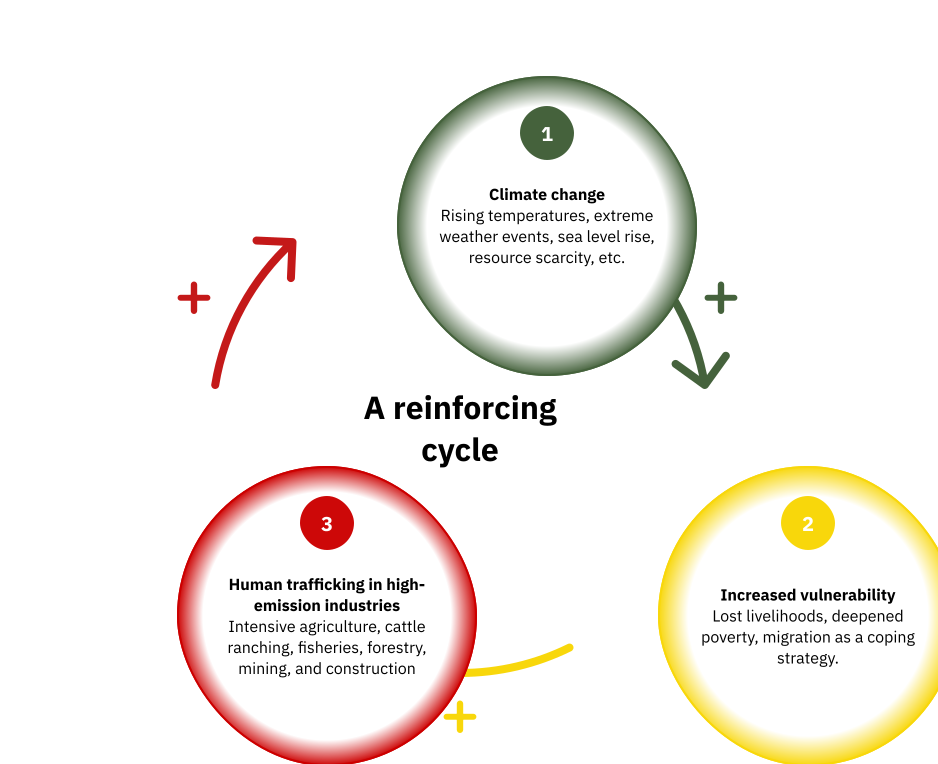
However, forced and child labour have also been identified in the supply chains of renewable energy products, including lithium batteries and solar panels, which are central to the green transition. This highlights a more complex dynamic: while these industries aim to mitigate climate change, they may still rely on exploitative labour practices (Brouwer, 2025).
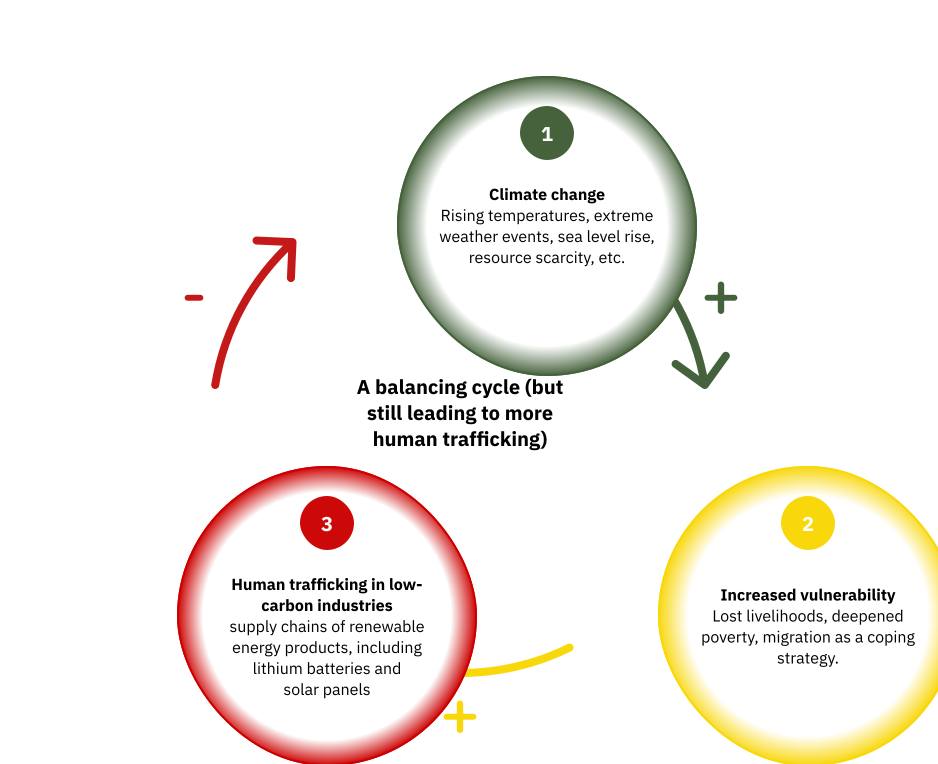
In this sense, efforts to address environmental challenges do not automatically translate into positive social outcomes. Despite the balancing feedback loop being formed, rather than representing a purely beneficial or “balancing” dynamic, this reflects a broader systemic issue in which exploitation persists across both high-emission and low-carbon sectors. Regardless of whether industries contribute to climate change or aim to mitigate it, the continued presence of human trafficking and forced labour across diverse sectors underscores the global, multi-faceted nature of the problem and its deeply embeddedness within contemporary economic systems.
5. Conclusion
The nexus between climate change, migration, and trafficking in persons is becoming increasingly evident, reflecting its complexity and deep interconnections with broader social, economic, and environmental challenges. A growing body of research highlights how climate change acts as a threat multiplier, exacerbating existing vulnerabilities and creating conditions in which exploitation and human trafficking can flourish. At the same time, leading institutions, including the International Organization for Migration, emphasize that this nexus remains underexplored and insufficiently reflected in policy frameworks at both national and international levels. This highlights the urgent need for more systematic integration of these interconnections into policymaking processes.
Despite growing attention, significant research gaps remain as well. Current evidence is largely based on case studies and is geographically concentrated in regions such as South and Southeast Asia. There is a need for more large-scale, quantitative research to better understand the causal pathways linking climate change and trafficking, including the role of slow-onset environmental changes. Further research is also needed to identify which population groups are most vulnerable and under what conditions. Expanding the geographical scope of research and deepening the evidence base are essential for informing effective and targeted policy responses.
A key implication is the lack of clear definitions and legal recognition of climate-related mobility. The absence of internationally agreed terminology and protection frameworks for climate migrants contributes to gaps in protection and may push affected populations toward irregular migration pathways, thereby increasing their vulnerability to exploitation and trafficking. Addressing this gap is essential to ensure that those most affected by climate change are adequately protected. In this context, improving migration governance is crucial – not only to reduce risks but also to recognize that, when properly managed, migration can serve as a positive adaptation strategy that enhances resilience to environmental change.
At the same time, policy responses must move beyond reactive approaches and place greater emphasis on prevention by addressing the root causes of vulnerability. Since climate change amplifies pre-existing inequalities – such as poverty, gender inequality, weak governance, and environmental degradation – effective responses must focus on strengthening socio-economic resilience. This includes investing in climate-resilient infrastructure, disaster preparedness and early warning systems, social protection mechanisms, and sustainable livelihood opportunities. By reducing structural vulnerabilities, such measures can limit the conditions that traffickers exploit and reduce the likelihood that affected populations resort to high-risk coping strategies.
Closely linked to this is the need for more integrated and systemic approaches to policymaking. The complexity of the climate-migration-trafficking nexus demonstrates that these issues cannot be addressed in isolation. A systems thinking approach allows policymakers to better understand interconnections, identify reinforcing feedback loops, and anticipate unintended consequences. Such an approach also supports the development of integrated strategies that simultaneously address climate adaptation, environmental protection, migration governance, and anti-trafficking efforts.
Importantly, these findings also highlight the need to avoid oversimplification. While climate change is an important driver of vulnerability, it should not be viewed in isolation or as the sole cause of migration and trafficking. Environmental change has always been a feature of human history, and vulnerability is shaped by a broader set of socio-political and economic factors, including governance deficits, and limited institutional capacity. At the same time, it is essential to recognize that contemporary climate change is anthropogenic, and therefore closely linked to governance systems, policy choices, and patterns of economic development. Framing climate change as an abstract or independent driver risks obscuring the underlying human and institutional decisions that contribute to both environmental degradation and social vulnerability. Effective responses must therefore place greater emphasis on governance structures and accountability, ensuring that policy decisions consider their long-term impacts on both human societies and natural systems.
In an increasingly interconnected and globalized world, challenges such as climate change, migration, and human trafficking are becoming more complex and interdependent. Addressing them requires not only deeper academic understanding, but also more coordinated, forward-looking, and integrated policy action. Recognizing and responding to these interlinkages is essential to ensuring both human security and sustainable development in the face of accelerating global change.
Бележки
- The Intergovernmental Panel on Climate Change (IPCC) is widely regarded as the premier global authority on climate science. [обратно]
- In the IPCC calibrated language system, the term “very likely” denotes a probability of occurrence greater than 90%. [обратно]
- Protocol to Prevent, Suppress and Punish Trafficking in Persons, Especially Women and Children [обратно]
- According to the Convention, a refugee is defined as a person who, “owing to a well-founded fear of being persecuted for reasons of race, religion, nationality, membership of a particular social group or political opinion, is outside the country of [their] nationality and is unable or, owing to such fear, unwilling to avail [themself] of the protection of that country; or who, not having a nationality and being outside the country of [their] former habitual residence, is unable or, owing to such fear, unwilling to return to it.” [обратно]
- The term “socio-ecological systems” refers to complex, integrated systems of people and nature, emphasizing that humans are not separate from the natural world but an inherent part of it (Berkes and Folke, 2000). [обратно]