

Introduction
Contemporary societies have undergone profound changes with the advent of the COVID-19 pandemic, which has established new social dynamics and different modes of interaction in environments that are no longer exclusively offline but also online, highlighting a shift toward a multidimensional, digital way of life (Lucini, 2021).
This has also influenced certain polarizing and radicalizing trends that now appear to be consolidated in most European countries, as well as the increasingly prominent role that new technologies have assumed in fostering involvement in extremist attitudes and radical behaviors.
The phenomenon of radicalization thus becomes a central issue to address, especially about its definition and the various interpretations that, starting from how the phenomenon is defined, are used to guide policies of prevention, de-radicalization, and counteraction.
The changes that have occurred in European societies in the post-pandemic years must be considered as bringing about a new and necessary perspective for understanding these phenomena and the polarizing and violent tendencies that are becoming increasingly widespread.
In this deeply volatile new scenario, a new security framework represents a central element for the governance of countries and their stability.
The systematization of the evolution of these radical phenomena can also be observed through consideration of the results obtained from two different European research projects in which the author has worked.
The first concerns the EU Horizon 2020 project TRIVALENT – Terrorism pReventIon Via rAdicaLisation countEr-NarraTive – in which considerable attention was devoted to the communicative dimension of Islamic religious and political extremism, subsequently focusing the operational proposal on two essential policy elements represented by alternative narratives and counter-narratives.
The second, the EU Horizon 2020 project COUNTER – Countering Radicalisation for a Safer World: Privacy-First Situational Awareness Platform for Violent Terrorism and Crime Prediction, Counter Radicalisation and Citizen Protection – focuses on the results of analyses and research carried out, which have shown, from an operational and methodological perspective, that current tools for preventing and understanding the threat of radicalization and violent extremism, namely TRA-Is (Terrorism Risk Assessment Tools), are no longer suitable for the social context in which they should be applied.
It is along this line, and with the aim of better understanding current and future policy orientations, that this contribution develops.
It begins with an in-depth examination of the different definitions of radicalization and the emergence of this concept, followed by an analysis and discussion of various policy approaches in European countries, with a focus on the Italian context.
Finally, future perspectives will be outlined both regarding the evolution of the threat and the prevention and management tools that appear most suitable and appropriate for the new international scenario and the current social context (Daher et al., 2025)
Radicalisation: defining the risk and navigating the noise
The concept of radicalisation is not new; it is rooted in the radical conception of 19th-century British political reform and subsequently emerged within the international landscape of the First World War. Throughout historical evolution, depending on the socio-political context, radicalisation and violent extremism have demonstrated their presence and destabilising impact on the governments and populations subjected to their effects.
In Europe and, more broadly, in Western countries, the concept of radicalisation systematically re-emerged following the attacks in the United States on September 11, 2001. From this point forward, both the public narrative promoted through various media channels and the political and legislative orientations adopted to manage the phenomenon began to disseminate the phrase “Islamic radicalisation,” associating it with specific ideological, religious, and cultural characteristics.
Consequently, for public opinion, the concept of radicalisation was transformed into an exclusive category pertaining to Islamic terrorism and religious extremism. Despite this sharp distinction in the definition of the concept, a wide range of diverse reflections emerged to address the question of what radicalisation entails, examined through psychological, sociological, political, and economic lenses. These factors are considered in relation to specific contexts and social environments where individuals may be exposed to the risk of radicalisation.
From a theoretical-academic perspective, Sedgwick (2010) argues that the term “radicalisation” depends on the formal context in which it is adopted—be it security, social integration, or foreign policy—thereby highlighting the multidimensional nature of the fields affected by the same radical phenomenon. This characteristic brings to light certain elements of conceptual confusion which are mirrored in the policy and legislative lines designed to manage and counter the phenomenon. In this regard, Neumann (2013) also emphasises the lack of a common definition and identifies a significant distinction: radicalisation can be recognised as cognitive radicalisation, based on extremist beliefs and ideas, or identified as behavioural radicalisation, founded on extremist actions. The distinction maintained is therefore between extremist thought and the commission of, or participation in, extremist and terrorist acts.
In this field, a more operational perspective to overcome definitional confusion is proposed by McCauley & Moskalenko (2008; 2011; 2017; 2020) with the Two-Pyramids model, which distinguishes between the radicalisation of opinions and ideas and the radicalisation of actions and behaviours. These two trajectories of radicalisation inform and constitute different methods of prevention, management, and response depending on the category to which an individual belongs. Furthermore, McCauley & Moskalenko (2017), in their critical reflection on the definition of radicalisation, cite the work of Moghaddam (2005) who:
in “The Staircase to Terrorism,” offered an early metaphor of radicalization as a six-floor ever-narrowing stairway to terrorism. The ground floor is perception of injustice and relative deprivation; the first floor is search for options; the second floor is anger at the perceived perpetrators of injustice; the third floor is a moral engagement that justifies terrorism; the fourth floor is joining a terrorist group; and the fifth and last floor is dehumanizing enemy civilians to make them legitimate targets of violence. […] The difference between justifying terrorism (third floor) and joining a terrorist group (fourth floor) is the difference between radical opinion and radical action. This key difference appears as just one more step in the staircase model.
This individual perspective, used to understand the concept of radicalisation and its underlying dynamics, constitutes the core of the theoretical and academic production in radicalisation studies. In subsequent years, it would direct the consideration of micro, meso, and macro approaches to the phenomena of radicalisation and extremism. Additionally, it should be noted that studies during those initial years of definitional reflection followed two theoretical lines.
The first is predominantly individualistic, from which profiling guidelines were structured from a methodological perspective, as the radicalised individual was at the centre of the phenomenon and had to be understood through their specific psychological and mental attitudes (Horgan 2005; 2014). From an operational perspective, this led to the development of TRA-Is (Terrorism Risk Assessment Tools) aimed at operationalising risk assessment and addressing the need to understand extremism and radicalisation risk for both prevention and de-radicalisation purposes (Lucini, 2023; 2024).
The second perspective is represented by the work of Wiktorowicz (2005), who focuses on radicalisation as an expression of social movements and social processes, highlighting the social nature of the radical phenomenon and the relevance of social identity construction in relation to the reference social network. The work of Della Porta and LaFree (2012) follows this perspective of considering radicalisation through the lens of social movements.
These two orientations have been, and remain, the primary pathways of theoretical debate regarding the definition of radicalisation and violent extremism, considering the influence of the disciplinary backgrounds of various scholars (e.g., psychology, sociology, criminology, political science). In later years, technological, political, social, and cultural changes—and more generally the international scenario—led to a broadening and further characterisation of these perspectives.
Specifically, there is a persistence of linear models and those predominantly oriented toward the individual path toward radical views and extremist behaviours. Alongside these, however, other studies have emerged regarding the definition of radicalisation and the understanding of dynamics and factors that can support such a phenomenon. In this regard, it is worth noting authors such as Cherif, R., et al. (2009), Borum (2011; 2014), Doosje et al. (2016), Hardy (2018), Van den Bos, K. (2018), and Schmid, A. P. (2013), who focus on possible pathways and models of radicalisation and extremism. Regarding specific risk factors and indicators, it is important to cite the studies by Lösel et al. (2018), Vergani et al. (2020), Kruglanski et al. (2019), Wolfowicz et al. (2020), and Duindam et al. (2025), which focus on different factors that can attract, sustain, and promote radicalisation processes, as well as provide a better understanding of their role in both off-line and on-line recruitment dynamics.
The theoretical perspectives offered raise an essential question for the definitions of radicalisation and violent extremism regarding the role of violence, as highlighted by Bartlett et al. (2010), cited by McCauley and Moskalenko (2017): “Becoming a terrorist was not always a natural or linear progression from being a radical. Those who turned to violence often followed a path of radicalisation which was characterised by a culture of violence, in-group peer pressure, and an internal code of honour where violence can be a route to accruing status. […].”
Bartlett and colleagues clearly emphasise that the path to becoming a terrorist does not follow a single trajectory with predefined factors. On the contrary, the construction of this identity lies in a complex, multidimensional journey in which various factors combine differently depending on the context and the technological access possessed by the individual or groups.
A more general point relative to the theoretical lines previously highlighted is represented by the definition of the phenomenon of radicalisation found in the Commission Implementing Regulation (EU) 2019/103 (European Commission, 2019), which defines radicalisation as follows:
“‘radicalisation’ means the phenomenon of socialisation to extremism of people embracing opinions, views and ideas, which could lead to terrorism.”
This definition is useful for defining a crucial characteristic of radicalisation: that it is a dynamic, vital, and continuously transforming process that permeates the mechanisms and dynamics of socialisation. These may fall within the sphere of primary socialisation (occurring in the family context) or within broader socialisation that includes different actors such as schools, peer groups, other reference adults, and—for nearly two decades now—new technologies and the world of social media communication. Indeed, it is this new actor that provides a novel perspective for understanding the phenomena of radicalisation and violent extremism.
Radicalisation: current and future perspectives
The increasingly growing social complexity, the interdependence of technological infrastructures that have become indispensable, and international scenarios of increasing vulnerability and uncertainty have led to a profound transformation in the processes of radicalisation and in the dynamics that may lead individuals or social groups towards violent extremism and, consequently, to the perpetration of terrorist attacks that are highly destabilising for personal, national, and international security.
In this highly intricate framework, it should not be overlooked that the advent of the pandemic in 2020 redefined the global social milieu, leading to a significant reconfiguration of social relations, both among individuals and between individuals and institutions, which also includes processes of radicalisation and phenomena of violent extremism.
In particular, references to the previous literature developed on these topics have shown how the evolution in the understanding and definition of these phenomena varies in accordance with governance, legislative, and technological elements.
The technological evolution of communication media has, over the last two decades, enabled important changes concerning the role of the public within media consumption contexts, shifting from a passive audience to an active one and a co-producer of digital content.
In this context, it has become evident to conceive processes of radicalisation as communicative and relational phenomena, focusing attention on the digital contexts in which these phenomena are activated and develop, considering the new dimension of life that, for most individuals, is situated in a hybrid zone between the off-line and the online dimension (Vergine et al., 2024).
In particular, the online dimension has been the subject of various studies (Conway, 2017; 2021; Ledwich and Zaitsev, 2019; Lavie-Driver and van der Linden, 2025; Núñez-Guerra, 2025) that have examined in depth the role of new technologies considered as both means and environments in which extremist individuals or those with initial polarising beliefs may find and disseminate radical and extremist materials and information aimed at recruitment and at the structuring of networks around the same or similar extremist ideologies.
In this context of study and research, a reflection has developed based on the results of several research projects for which Lombardi, Maiolino and Lucini (2020) and Lombardi and Lucini (2021) conceptualised a new perspective with the aim of better understanding and delineating the phenomenon of online radicalisation, developing the perspective of the FORMAT model. Through this perspective, a certain type of static conception of the network is overcome—according to which what occurs online remains confined to that dimension—and a communicative alternative is proposed to the approach of alternative narratives and counter-narratives that had, for several years, dominated prevention and counteraction activities related to processes of radicalisation and violent extremism.
The FORMAT model proposes a different paradigm centred on the communicative dimension of phenomena of polarisation and extremism, focusing on: “The format model is constituted by two key elements such as communication ecosystem and narrative-scape.” (Lombardi, Maiolino and Lucini, 2020), thereby highlighting, for the first time, the central role played by communication ecosystems and narrative-scapes: from being merely media and technological contexts, they become key actors in processes of polarisation, radicalisation, and extremism.
In accordance with this reflection, the transition also occurs across different levels of analysis, insofar as the first—developed by various institutional and social actors—focused on prevention with particular attention to individual narratives circulating online and therefore on the construction of alternative or counter-narratives; the FORMAT model, instead, shifts the level of analysis to the media context, understood no longer as a passive actor but as a crucial element for the prevention and countering of radicalisation. In particular, “The format is a media-cultural product consisting of communication guidelines to implement when considering feelings, emotions, perceptions of an audience; types of narrations; features of the current scenario and narrative-scapes adapted to the single communication ecosystem and for the specific purpose of the communication process.” (Lombardi, Maiolino and Lucini, 2020).
This perspective highlights and anticipates by several years the specific attention that will be paid to new processes of radicalisation, risk scenarios, and novel elements (Lucini, 2024°; 2025a; 2025b), such as:
- radicalisation processes are situated within a digital dimension that encompasses both the off-line and the on-line dimensions, resulting in the new term proposed by Floridi (2014), namely on-life. Radicalisation thus assumes both a cognitive and an emotional connotation, which become central within the new context of digital communication ecosystems. In particular, the cognitive dimension is especially relevant for the interaction that potentially vulnerable individuals and groups have with the digital environment and with platform tools and artificial intelligence. In accordance with this perspective, propaganda and recruitment activities (Lucini, 2022) are facilitated. The latter have also been studied from the perspective of vetting, and therefore of a selection–filtering process
- the context in which dynamics of radicalisation and violent extremism develop, including through phenomena such as hate speech or the polarisation of discourse, becomes a central actor that can be recognised in the characteristics of pervasiveness, permanence, and interdependence typical of digital communication ecosystems (Lucini, 2024b). This is also evident from the shift in focus from specific radicalisation factors rooted in the sphere of mental health and structural vulnerabilities (familial, socio-educational, economic-labour) towards consideration of the role that communicative dynamics and relationships play in sustaining polarised and radical attitudes, ideas, and behaviours;
- another central element in this new perspective on the phenomenon of radicalisation concerns ideological hybridisation or the volatile ideological-cultural context in which polarising dynamics develop within digital communication ecosystems (Lucini, 2017): there are no longer models of purely ideological radicalisation, but rather an evident ideological blending that has been defined by various scholars as “salad-bar extremism” or also as phenomena of double radicalisation, whereby some individuals radicalise according to one ideology and subsequently change orientation to embrace extremist cultural approaches of an opposite nature. Examples in this regard include cases of ideological fusion such as the phenomenon of narrative syncretism between accelerationists and salafi-jihadists as studied by Argentino et al. (2022), and that of “Composite Violent Extremism” coined by Gartenstein-Ross et al. (2022);
- a necessary revision of terrorism assessment tools – TRA-Is in order to align them with new forms of radicalisation and extremism, thus making them current and resilient with respect to ongoing social changes (Lucini, 2023; 2024c; Lahnala et al., 2025);
- youth and minors emerge as a specific target for dynamics of radicalisation and extremism, with certain trends that are progressively consolidating;
- the impact that the geopolitical and international situation has on the stability and security of various countries, their governments, and populations, as well as on polarising digital dynamics, extremist communication, and social radicalisation
These new elements emerging from the analysis of the definition and the different conceptualisations of the phenomenon and processes of radicalisation confirm the context-sensitive nature of the phenomenon and the need to examine in detail policy analyses for the prevention and countering of radicalisation and extremism promoted by various institutional agencies of the European Union, with the aim of better understanding the influence that underlying theoretical paradigms have in shaping the understanding of social phenomena and the future perspectives that may emerge.
Policies for prevention and countering radicalisation and extremism
Prevention, management, and countering strategies and policies addressing phenomena of radicalisation, violent extremism, and terrorism have been systematised since the early 2000s following the spread of attacks carried out in the United States and Europe by Islamist extremists.
Strategic orientations and operational practices are influenced by the typology of the phenomena and by the characteristics of contemporary threat.
In considering the architecture of legislative perspectives and policies, it is necessary to recall the theoretical framework and its evolution as previously discussed, which highlights key features of the phenomenon that guide operational applications and the activities implemented for the purposes of prevention, management, and countering of radicalisation processes and violent extremism.
In this regard, it is possible to identify several fundamental phases of these orientations and the practices they have generated.
Indeed, in the early 2000s up to approximately 2010, strategic orientations focused on intelligence activities and on a predominantly defensive security approach. These were years characterised by efforts to understand the threat from an international perspective and with the aim of better comprehending its dynamics. In the subsequent five years, an orientation towards networking capacity and information-sharing among agencies and law enforcement at the European level prevailed, highlighting the need to share common technological systems for information exchange, as well as linguistic and cultural codes that would enable dialogue among Member States and their security agencies. Subsequently, and up to the 2020s, there has been a predominance of operational approaches linked to technological evolution and to the exploitation by extremist actors of the online dimension and the opportunities it offers for recruitment, dissemination, and sharing of extremist materials and information. These are also the years in which, from a theoretical perspective, the role of ideologies begins to weaken in radical and extremist scenarios, giving way to more diverse forms of extremism with varying ideological bases and with phenomena of double or multiple radicalisation.
During this period, policy orientations are therefore directed towards a greater understanding of the threat and of its exploitation of the internet for purposes of destabilisation, propaganda, and dissemination of extremist material. Moreover, considering the emerging ideological–cultural diversity, multi-agency approaches are supported for prevention activities, to manage the complexity of the threat and the multiple risk factors that are increasingly consolidating, including within the online dimension.
Finally, in the most recent years, starting from 2020, the previous perspective has been consolidated, with an even stronger focus on digital security and on the governance of extremist phenomena that now develop through a continuous interweaving of the offline and online dimensions.
The threat thus becomes hybrid both in its ideological–cultural characteristics and in its use of digital technologies for extremist purposes and for domestic and international terrorism.
The figure below summarises the essential milestones in the evolution of European policies on radicalisation and violent extremism.
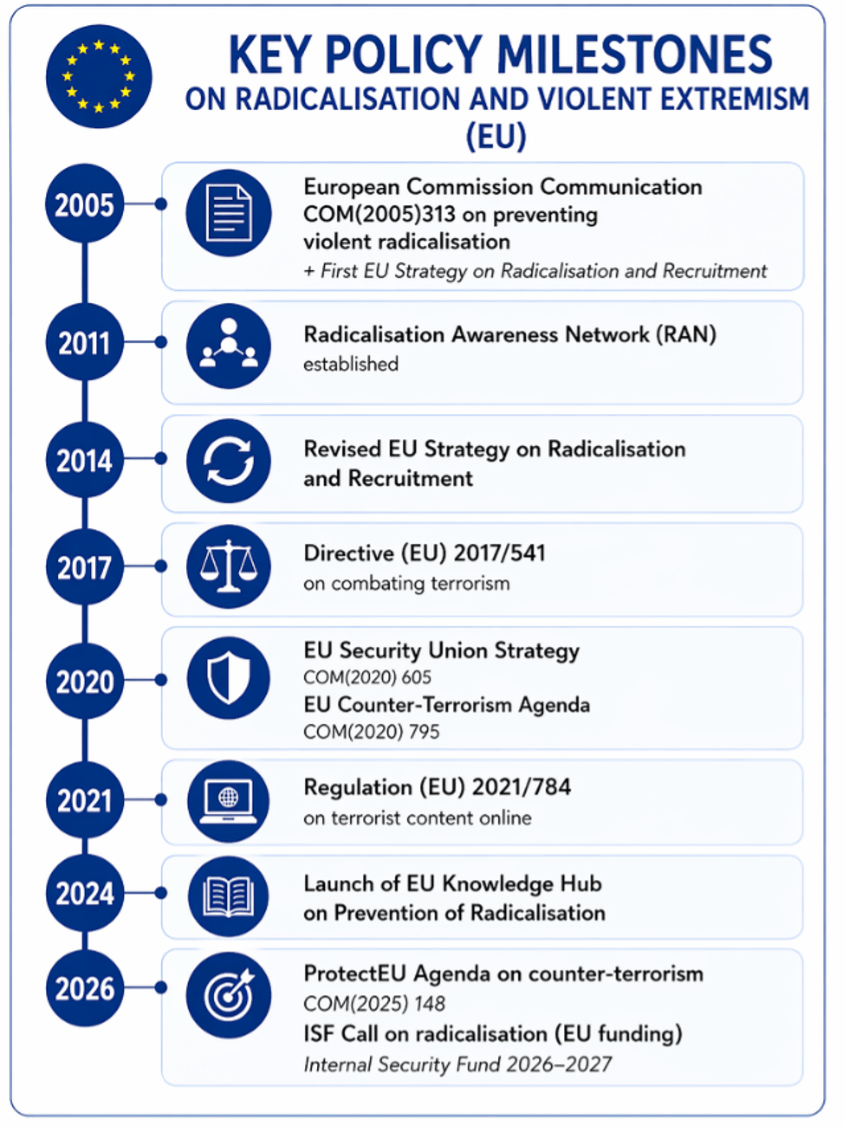
More specifically, the first communications of the European Commission framed the phenomenon within the domain of security and prevention, culminating in the Strategy for Combating Radicalisation and Recruitment in its revised and final form in 2014, which also included the phenomenon of foreign fighters, considered at that time as a key element in radicalisation dynamics and in the events that occurred. The development of the Radicalisation Awareness Network (RAN) in 2011—which in 2024 became the EU Knowledge Hub—demonstrates the relevance of a network-based and multi-agency approach for the study and understanding of increasingly complex and rapidly evolving threats and risks, particularly in light of technological evolution and the opportunities it offers in terms of recruitment, organisation, and dissemination of extremist and radical ideas.
The year 2020 marks the point at which the European Union systematised its approach through the Security Union Strategy (European Commission, 2020a) and the Counter-Terrorism Agenda (European Commission, 2020b), which consider activities of anticipation, prevention, protection, and response, identifying radicalisation as a complex, multidimensional phenomenon rooted in a social dimension, the understanding of which requires further in-depth analysis.
Technological evolution and the digital dimension are addressed in relation to the ways in which extremist individuals and groups may exploit them, notably with the adoption of Regulation (EU) 2021/784, which focuses on the security of the digital environment and the protection of fundamental rights.
In recent years, the European policy framework for the prevention, management, and countering of radicalisation and violent extremism appears to be oriented towards a greater awareness of the complexity of the threat and its destabilising characteristics, emphasising the need for a multi-level approach and for coordinated prevention policies capable of supporting the management of risk and extremist threats.
This framework is not without limitations and vulnerabilities, for instance regarding the need to harmonise legal and operational frameworks across different European countries.
In this regard, and by way of example, the Italian case may be considered, which appears particularly distinctive given the country’s specific national history in the prevention of and fight against organised crime.
The figure below illustrates the temporal evolution of the policies adopted by Italy for the management of phenomena of radicalisation and violent extremism.
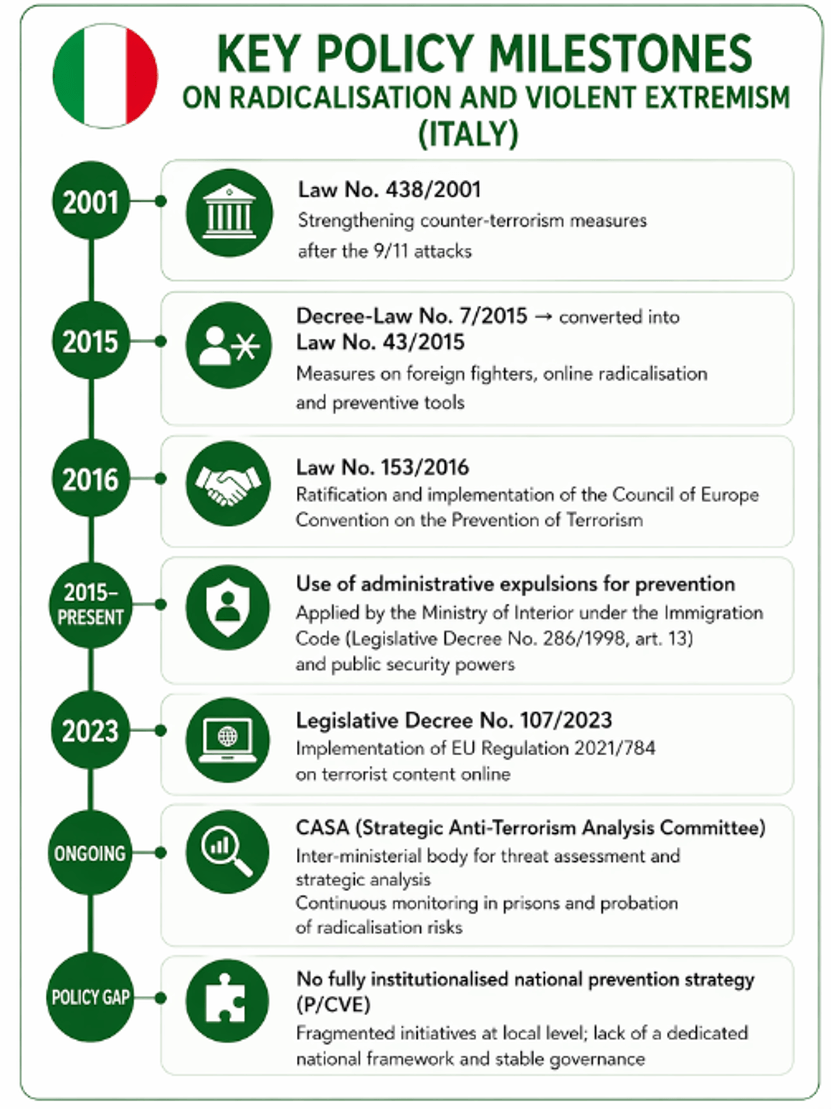
The Italian model develops along key milestones that illustrate the progressive adoption of European legislative and policy frameworks, resulting in a robust legal apparatus but a weaker implementation of prevention strategies.
From 2015 onwards and in subsequent years, priorities for Italy also include the consideration of the phenomenon of foreign fighters and online radicalisation as a new environment for the dissemination and development of increasingly ideologically diverse forms of extremism.
Furthermore, with regard to the Italian case, it is important to highlight the establishment of the Strategic Anti-Terrorism Analysis Committee (CASA) in 2004, which formalised a policy orientation centred on the need for networking among different security agencies and on the primary focus of information-sharing. This also underscores the necessity of a communicative context that not only shares common perspectives but also linguistic and cultural codes that enable the multiple professional actors involved to understand each other effectively and to translate their activities into effective preventive and countering policy practices.
The Italian case is also useful in emphasising the need to better structure and systematise national prevention and countering strategies (P/CVE), in light of the local fragmentation and dispersion that are often associated with such initiatives and activities, not only in Italy.
Finally, the ultimate objective of policy frameworks, both at the European level and within individual Member States, should be to translate into policy orientations the significant social transformations taking place in European societies, which increasingly involve forms of radicalisation that are diffuse and volatile, and therefore difficult to define in terms of specific ideological characteristics and cultural reference systems.
Recommendations and Conclusion
The presentation of the crucial aspects emerging from the different theoretical approaches to the definition of radicalisation and violent extremism, as well as the evolutionary overview of European policies for the prevention and countering of forms of radicalisation and extremism, makes it possible to reach several essential considerations that are useful for better capturing the “noise” referred to in the title, which can be understood as a contemporary multiplicity of forms of radicalisation characterised by a low degree of ideological orientation, multidimensionality, and volatility in their evolution.
The first aspect to be emphasised, therefore, is the need to redefine security approaches and the related policies in order to better propose guidelines and prevention and countering activities that are aligned with the historical, political, cultural, economic, and social transformations of contemporary societies and that take into account the characteristics of the current threat.
This is related to the awareness that the concept of radicalisation, from both a theoretical and an identificatory perspective, cannot be defined a priori nor taken as given, as demonstrated by contemporary events; rather, it confirms its context-sensitive nature. This characteristic is precisely the reason why, as previously discussed, it becomes necessary to focus on the context and on the central role it plays in processes of radicalisation and in the dynamics of violent extremism.
In this regard, the context is also shaped by the representation provided by institutional agencies and digital media, taking into account the effects that such representations have on the perception of these phenomena and of their transformations.
By way of example, one may consider the two reports produced in 2025 by Europol (EU TE-SAT) and the European Institute for Counter Terrorism and Conflict Prevention (EICTP), which combine an analysis of radicalisation, terrorism, and violent extremism trends using both empirical data and predictive analysis.
An important finding emerging from both reports is the decrease in terrorist attacks in Europe; however, alongside this trend, there is also the previously identified tendency of an emerging threat that is increasingly complex, interconnected with multiple variables, and more difficult to predict.
Both reports highlight growing concern regarding the use of digital technologies and the ways in which extremist groups and radicalised individuals may exploit them to disseminate content and recruit potential future radicals, thereby transcending ideological boundaries and rendering this threat similar across different ideological perspectives.
Significant differences between the two reports also emerge, which are useful for understanding the security approaches necessary to reconfigure strategic and policy frameworks in light of evolving threats.
Specifically, the two reports differ in their methodological approaches: the Europol report is based on a data-driven analysis, whereas the EICTP report proposes a predictive analysis oriented towards future developments. Moreover, the latter considers threats arising from the complex and challenging international context, viewing geopolitical scenarios as potential risk factors and sources of instability for European societies.
What emerges very clearly is a transformation in the nature of the threat, which appears significantly less defined by a specific ideological perspective, increasingly technology-oriented, and capable of absorbing the destabilising potential stemming from international tensions and conflicts, thereby intercepting vulnerabilities that are partly latent within European countries.
Starting from the consideration that the context of digital communication ecosystems (Lucini, 2024) represents the scenario understood as a proactive actor in current radicalisation processes, it becomes necessary to better understand which policy orientations should be adopted, considering their evolution and potential.
Over the years of their implementation, policies for the prevention and countering of radicalisation and extremism have revealed several methodological and operational limitations:
- a weakness in design (Charkawi et al., 2024), which is reflected in methodological implementation, due to the lack of standardised indicators that can be replicated across different contexts for which they were developed, as well as difficulties in measurement;
- difficulties in evaluating effectiveness, both for prevention programmes and for countering initiatives, due to methodological challenges in measuring their actual impact (Milbradt and Greuel, 2024; Ludden et al., 2022; Hofman et al., 2018);
- fragmentation in the design and implementation of policies and programmes across different European countries (Antonelli et al., 2024)
These aspects need to be more thoroughly considered within the European security approach, given their implications for understanding the effectiveness of prevention and countering programmes related to radicalisation.
More specifically, several elements emerge as priorities, concerning both the theoretical and the methodological–operational dimensions.
With regard to the theoretical perspective, there is a need to deepen knowledge of current radicalisation processes and the socio-cultural dynamics underlying them.
The ideological indifferentiation of current forms of radicalisation signals a significant transformation of the threat that requires further definition, also in order to provide law enforcement agencies and stakeholders with linguistic and cultural codes through which cooperation among different actors can be effectively implemented, in line with the multi-agency logic that remains a core European policy orientation.
In this context, it is also necessary to reconsider the role of emotional drivers (Lucini, 2025a) in contemporary radicalisation and how these activate radicalisation processes and extremist phenomena among minors, who can be considered the primary target of prevention interventions and programmes, particularly with regard to the use of social media and new artificial intelligence technologies.
Contemporary radicalisation is in fact diffuse and activated by perceptions, emotions, and personal interpretations that are not always linked to, or attributable to, specific ideological value systems and extremist groups. From this perspective, the threat appears more subtle and more difficult to predict; however, this should not lead to abandoning the possibility of continuous monitoring and the identification of behavioural patterns which, if adequately contextualised, may provide a certain level of predictability.
With regard to the methodological and operational perspective, a revision of the security paradigm adopted thus far is required, as the emerging threat is configured as multi-layered. As such, a new paradigm for prevention and countering should be identified that takes this characteristic into account as a necessary evolution of the previous multi-agency approach. The latter remains fundamental within this new framework, as the nature of the threat involves a variety of actors, and therefore inter-agency collaboration constitutes a cornerstone of prevention and countering strategies.
At the operational level, a revision of current prevention and countering programmes for radicalisation is required, taking into account changes in the nature of threats, the limitations in effectiveness and evaluation of programmes implemented thus far, and the introduction of horizon scanning activities typical of risk management approaches. Such activities could prove highly useful for understanding radicalisation and extremism dynamics in contexts characterised by low specific ideological orientation but high multidimensional vulnerability.
Finally, with regard to specific policy orientations that may be subject to further analysis and discussion, the following can be identified:
- recognising the context, both national and international, not merely as a background or setting for social processes of radicalisation, but as an active actor capable of shaping the adoption of certain radical views and behaviours;
- recognising the volatile nature—and therefore the adaptive and resilient character—of radicalisation processes (Lucini, 2025b), understood as forms of extremist and radical socialisation that may result in violent behaviour and terrorist acts;
- recognising the communicative dimension (Lucini, 2024) as central both to the identification and monitoring of the threat and to its subsequent management and countering;
- acknowledging that the specific communicative dimension, which also pertains to law enforcement agencies, is linked to the need to consider the impact and opportunities created by new technological tools;
- overcoming the limitations identified in the implementation of prevention and countering programmes by placing greater emphasis on the possible standardisation of policy design and their interventions;
- training as a fundamental element, along with the promotion of programmes—for example for law enforcement agencies, civil society, and stakeholders—focused on the evolving nature of the threat, the role of new technologies, and potential methodologies for prevention and countering programmes.
This represents an opportunity to integrate multi-agency and multi-layer security perspectives, leading to a new understanding of current threats and of the methodologies for identifying, monitoring, preventing, and countering radicalisation processes and violent extremism.
Finally, in light of recent cases occurring in various European countries and the trends that appear to be increasingly confirmed, it is necessary to consider the youth population as a primary target for future initiatives related to training on the use of new technologies, in order to promote greater and broader awareness of the central and strategic role that communication plays in identity construction, in the dissemination of extremist and radical ideas, in recruitment, and in the organisation of acts of violent extremism and terrorism.